Set Her Free

I've found myself in a most toxic relationship
She wakes up each morning 
Eager to fulfill my dreams
A thankless role she plays
The recipient of an endless onslaught
of judgment, criticism, and disappointment
Often cruelly starved
of love and appreciation
of human kindness
And yet I know she'll cling with every last breath
I know she will not leave
Compliments, praise, adoration from passersby
Never quite filling the void of affection
From the one who matters most 
I watch myself belittle and degrade her
I see myself compare her to every woman on the street
Observing this treatment of women by anyone else
Lights a fire of rage within me

Somehow those standards crumble 
When applied to the heartbreak at my own hand
I know it's not about her
My anger, sadness, and fear
They're all my own
Why can't I love her the way I'm supposed to?
I know we're destined to be
She was designed just for me 
I've found myself in a most toxic relationship
I'll spend my life trying to set her free
My body deserves nothing but love from me

Own It

Joe Biden and Kamala Harris are all but declared the President- and Vice President-Elect of the United States. This moment is a complex whirl of emotions and reflections for many of us, as we celebrate a victory, mourn many losses (economic, viral, and political), and reconcile with the reality that our country is much more deeply divided than we wanted to admit. Instead of throwing victory parties, for many this is a moment of silence, and not necessarily because COVID-19 inhibits us from embracing each other with joy. With the sigh of relief comes a pit in our stomachs as we look out at all the work ahead of us.

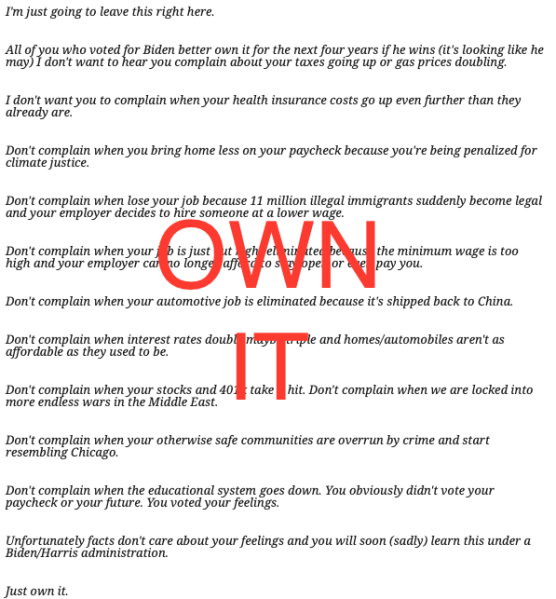
As always, many of us are taking to the internet to share our thoughts as Election Day (read: Week) winds down. A statement is going around reflecting a Trump supporter’s condemnation of Biden voters in light of the impending election results. As it truly made me think, and I took it to heart, I feel it warrants a response. Let’s go line-by-line. (original post in red)

I’m just going to leave this right here. All of you who voted for Biden better own it for the next four years if he wins (it’s looking like he may) I don’t want to hear you complain about your taxes going up or gas prices doubling.

There are two possible interpretations of this introduction. The first would be that the author is speaking to the very privileged and wealthy demographics in our nation, as those are the only groups (those who make over $400k/year) whose taxes even have the potential of changing under Biden. Though this does not include me, I can firmly say that those are prices I’m willing to pay. Had I voted to (fallaciously) keep my taxes low or to suppress gas prices, I would be telling you the price I’ve put on human rights. On decency. At second glance, I’m aware that the author may misunderstand or, more likely, be misrepresenting Biden’s economic policies and thus be attempting to address Biden voters in their entirety. In this case, it is essential to reiterate that these claims are simply baseless. The fear-mongering that Trump has employed to scare people into thinking they can’t afford to live in Biden’s America is a political tactic as old as time. The aim is to make us fear for ourselves, our families, and our livelihoods. To scare us into voting. To inhibit us from voting for the betterment of our nation by making us fear for our own survival.

I don’t want you to complain when your health insurance costs go up even further than they already are.

It is a fundamental tenet of the Democratic platform to make health care more accessible. Though we don’t all agree on the right way to do that, it is at minimum a conversation we refuse to stop having. Trump had no health care plan. Under a Trump administration, my family was at serious risk of losing healthcare, as were millions of others. If you voted on health care, you voted for Biden.

Don’t complain when you bring home less on your paycheck because you’re being penalized for climate justice.

On this argument, I reference my first response. There are some things in this world for which there is a price I am willing to pay. Climate justice and sustainability fall into that category. The short-sided and selfish nature of the argument that we should sacrifice the environment, our children’s planet, and the livelihoods of the marginalized communities beings severely impacted by climate change to save a few cents on the dollar is mind-boggling. Moreover, the overwhelming evidence falls on the side of sustainability and the green energy revolution being the basis for driving economic growth in the long-term.

Don’t complain when lose your job because 11 million illegal immigrants suddenly become legal and your employer decides to hire someone at a lower wage.

This response is painfully ignorant of the realities of our immigration system and the way it interacts with our economy. Our immigrant workforce drives prosperity in this nation. Not only does their legal participation in the economy increase tax revenue and the flow of money, but they most frequently take the jobs that Americans aren’t willing to. Most often, immigrants put more into our economy than they take, as they often aren’t able to take advantage of many of our social services. Even more, immigrants are a critical component of the diversity of thought and perspective that perpetuates the innovation and advancements that keep this country on the forefront of progress and prosperity. All of that aside, at a fundamental, human level, it goes against the basic principles of America’s creation to turn away those seeking betterment and opportunity.

Don’t complain when your job is just out right eliminated because the minimum wage is too high and your employer can no longer afford to stay open or even pay you.

Despite this point’s implicit contradiction with the prior statement that employers will be hiring newly legalized immigrants for cheap, short-term job loss is an incomplete assessment of minimum wage increase. First and foremost, the industries in which low-wage jobs are concentrated are traditionally some of the fastest growing sectors in our economy. A common misunderstanding on the topic of minimum wage surrounds who is employing these workers and will thus be most impacted. The vast majority of minimum wage workers are actually employed by large corporations, not small businesses. These are corporations who can afford the pay increase, have traditionally taken advantage of workers at the bottom, and consistently compensate executives and shareholders disproportionately. Yes, there is potential for a minimum wage increase to initially eliminate some jobs; however, it puts more money in the hands of more Americans who, in turn, perpetuate the economy and drive growth at a higher rate than if we were to continue concentrating the wealth with the top executives.

Don’t complain when your automotive job is eliminated because it’s shipped back to China.

Explicitly outlined in Biden’s platform is his plan to penalize American companies for moving jobs overseas. Of the two candidates in question, Trump poses a much larger threat to Americans in the form of frighteningly friendly relationships with some countries, like China, and his apparent desire to benefit their leaders and economies.

Don’t complain when interest rates double maybe triple and homes/automobiles aren’t as affordable as they used to be.

Let’s get one thing straight: homes aren’t affordable and haven’t been for some time. Many millennials and Gen Z’s are reconciling the fact that home ownership, a traditional pillar of the American Dream, may be out of the question for us. However, an increase in wages and a commitment to providing the necessities of health care and education would put a lot of us much closer to that dream. Further, Biden’s commitment to tackling COVID head-on and getting the economy back on track provides a better outlook for those of us trying to make those big investments. As for the claim that interest rates will double or triple under Biden, there is quite simply zero evidence to believe that will be the case, especially in this unprecedented time of recession and pandemic. In fact, as part of Biden’s plans to pay specific attention to race in his quest for economic recovery, he has outlined how there may actually be good reason to hold interest rates lower for longer due to the disproportionate impact on Black communities.

Don’t complain when your stocks and 401k take a hit. Don’t complain when we are locked into more endless wars in the Middle East.

Looking specifically at the most likely outcome of this election, we know that, historically, the stock market actually performs best under a Democratic president and a Republican senate. Moreover, there is negligible correlation between the party in the White House and the performance of the economy. As for foreign policy, Biden ran on plans to end wars in the Middle East and continue investment in our military.

Don’t complain when your otherwise safe communities are overrun by crime and start resembling Chicago.

The claim that Trump’s America is safer than Biden’s America could only possibly hold true in a world in which Trump continues to incite violence and encourage chaos upon his defeat. In reality, I feel much safer about my life as a woman in a diverse city with a history of crime (Washington, D.C) under a Democratic president. Police reform is beyond necessary, and many Democrats would argue defunding would actually be more effective. However, the argument is not for national free-for-all. In place of our law enforcement institutions, rooted in minority suppression, racial discrimination, and state-sponsored violence, many of the proposed alternatives involve community-oriented programs with specific emphasis on effectively addressing the problems we face. For example, investing in education and intervention resources for domestic violence, funneling money into rehabilitation, and eliminating the guns on our streets are only a few of the proposals. It is not just about eradicating the system, it is about replacing the system – changing the way we think about crime, safety, and community; creating new infrastructure for keeping our citizens safe; and developing institutions that protect all Americans. Most importantly, the law enforcement reform policies go hand-in-hand with the liberal platform as a whole. By decriminalizing drugs, making health care accessible, expanding education, funding community services, and empowering racial minorities, we eliminate so much of the threat at the source. All of that said, it is worth remembering that Biden is actually quite moderate when it comes to police funding. Much to the chagrin of more bullish liberals, he has refused to commit to any defunding, so Trump supporters can sleep soundly.

Don’t complain when the educational system goes down. You obviously didn’t vote your paycheck or your future. You voted your feelings.

It is unclear why or how the author thinks the educational system is going down, especially given that Democrats are more likely to invest in public education, make college affordable, and provide alternative schooling opportunities. However, yes, I did vote my feelings. I voted policies and principles and platforms. But I also voted my feelings. I voted hope and unity and decency. I voted equality and empathy and empowerment. I voted that gut feeling that made me cringe and fear for myself and my neighbors each time Trump took to Twitter and his supporters took to the streets. I voted the overwhelming optimism of our young progressives standing up for what is right. I voted Biden.

Unfortunately facts don’t care about your feelings and you will soon (sadly) learn this under a Biden/Harris administration. Just own it.

After 4 years of Republicans turning a blind eye to Trump’s antics, it’s a bit comical to ask us to own anything. However –

I own it. I own every morsel of what my vote stands for. I own it proudly.

The Racial Reality

content warning: violence, injury, racial slurs


Though I spend every morning listening to political podcasts that constantly discuss racial tensions and identity politics, I have never been faced with the truths of race in America the way I was on August 14, 2018. We go numb to so many of these issues as the news stories become commonplace and redundant- it took a violent, harsh, and tangible reckoning with reality to make me even begin to fully digest the status of racial relations in this country. And yet, my conclusion is quite simply that it is complicated. And it needs to change.

Let me explain.

I was walking home from the metro after work at about 6pm on a Tuesday. Minding my own business (admittedly paying attention to very little besides my iPhone), I was startled by commotion and yelling on the sidewalk in front of me. As I got closer and saw through the people gathered around, I was accosted by the sight of a small, white woman laying on the ground in a pool of her own blood. Never before had I seen such injury in real life.

I approached the people surrounding her and made sure that someone was calling the police and an ambulance; then, I began to investigate. As it turns out, this woman’s misfortune was the result of a racially-charged altercation on the public bus. She had started an argument with some black bus riders, asking them to turn down their loud music because she found it offensive and annoying. Apparently, this dispute escalated on the bus, and it resulted in her aggressively calling them all “n****rs” as she got off at the stop. A black man and woman also got off the bus, and the man proceeded to hit her in the back of the head. The woman then attacked her.

Both of the physical aggressors left, and the bus driver drove away without calling the police or checking on the woman.

By the time I was with her, the woman was laying on the sidewalk, screaming through a mouthful of blood that “she is so tired of being treated like trash simply because she is white,” that “white lives matter,” and that she “hates living in a black neighborhood.”

Upon hearing the story and observing the victim’s behavior, I selfishly followed my thoughts straight to the strain this put on my personal values. This woman treated her fellow bus riders with a level of disrespect that is absolutely unacceptable. She was then espousing racial beliefs that I registered as abhorrent. How could I continue to sympathize with her?

Yet I couldn’t leave. There was a woman in need of urgent medical attention. Despite her treatment of fellow Americans, she was treated as less than human in the physical attack. No name-calling or verbal slurs could possibly warrant such a response. I felt conflicted. The outspoken political activist inside me wanted to argue with her about her claims of white struggle. But this was not the time nor the place.

After being sure that she was in the hands of medical professionals, I continued my walk home and reflected upon the jarring experience. Two things occurred to me that will forever change my perspective:

(1) Her experiences are real. And her experiences are valid. A history of black oppression and mistreatment does not negate the horrendous treatment she received at the hands of black citizens. While her views on racial relations may be limited to her life and do not include the reality of racial inequalities on a larger scale, she has a real and true hatred brewing inside. This should be a concern for each and every political affiliation. Whether she is “wrong” or “right” is secondary. She feels threatened and mistreated by the black people in her community, just as many black citizens feel about their relationships with white community members. These tensions feed animosity, violence, and cultural divide. The adversarial nature of race relations in this country, the pitting of blacks against whites, is dangerous – for both groups.

Recognizing that my polar opposite political and racial views don’t negate the reality of her experience, her trauma, and the development of her ideology forced me to acknowledge the severity of the disrepair in the state of American race relations.

(2) The horrendous altercation resulted in a championing of black character. It wasn’t until I was removed from the adrenaline and terror of the situation that it dawned on me- the woman who was on the phone with the police and helping the victim clean her wounds was black; the man who chased down the bus to document the bus number and the driver who left the scene of the crime was black. The heroes were black. The heroes were black in a situation where a racist white woman was the victim of a crime at the hands of  two black people.

For me, this served as a reminder that no one race is good or evil. People are good and people are evil. There are gracious and kind citizens of every color. More importantly, people are not inherently compelled to side with the people who look like them- I felt sympathy for those who were aggressively called racial slurs, and the black woman helped the white woman in pain. Further, a victim can still be a victim and also not be innocent. The woman who was attacked behaved horribly and treated others in an unacceptable manner; however, she in no way justified a physical attack. These situations are so very complicated. Race relations are so very complicated.

If nothing else, it is a call to everyone, especially white people, to be the heroes, not the bystanders. No matter the color of the victim, mistreatment of people is unacceptable, and there is no excuse for standing idly by.

While this traumatizing experience did more to complicate my understanding of racial relations than clarify it, it made one thing clear as day: this country does not operate on a system of functional societal interactions. The behaviors we demonstrate and the hatred we fuel is not only counterproductive but unsustainable. We are in dire need of a drastic transformation of the way we interact, the way we speak, and the way we think about our neighbors.

Tests, Trump, and Tactics

Professor Nicholas Didow of Kenan-Flagler Business School requested on the midterm exam for his Global Marketing class that students address an article in The Economist titled America’s New Business Model in the form of a letter to the Editor. Inspired by the relevance and applicability of this academic endeavor, I thought it pertinent to share what I would say to the Editor and, should he be willing to listen, to Trump:

Dear Editor:

I agree with the general premise of this article: Trump’s promises and policies are contradictory, short-sighted, and politically savvy.

President Trump’s brilliance lies in his ability to monopolize global attention with the grandiose declaration of promises that appeal to the underinformed citizen whose short-term time horizon favors quick-fixes and drastic measures. Often criticized by opponents for his lashing out on social media and attacks on corporate leaders, Trump has successfully convinced the American public that he will be their economic advocate without yet having to incur any of the costs or losses of political capital should he actually implement all-encompassing policy measures.

There is no mystery to the appeal of Trump’s economic policies to the American workforce. Despite the notable improvements made during the last administration, the nation is still very much so recovering from economic turmoil, and the memory is fresh in the minds of constituents. Playing to the desire for job security and global competitiveness is a safe political move. His tactics, though, do not account for the long-term need for labor force adaptation and the danger of political unpredictability. By demonizing any firm that looks abroad, Trump effectively bolsters American elitism and isolationism, undermining what may have been opportunities to better serve the American consumer. His promise of tariffs on goods produced elsewhere takes a protectionist economic tool designed to differentiate between the corporations of different nations and transforms it into a mechanism for internal conflict and nepotism as well, heightening the potential disadvantageous effects. For a leader who praises capitalism and old-fashioned hard work, his interventionist tendencies and erratic actions counteract the market forces at play. This isolationism is increasingly detrimental when the modern global socio-political climate is taken into account; the largest threats facing society include violent non-state actors, the collective action problem presented by climate change, and the international automation of operations. These obstacles will require collaboration, cooperation, and commitment.

Neorealist thought, championed by Kenneth Waltz, suggests that the state’s main purpose and function is to maintain security. Protectionism appears to be a mechanism for guaranteed security, as it eliminates the possible entry of an external threat; however, a new threat can emerge from within, as efficiency, opportunity, and competition suffer from manufactured constraints. Contrarily, a highly-competitive global marketplace may simultaneously seem to facilitate security, especially in the form of power. If a nation is able to generate competitive advantages and increase efficacy, the bargaining power, relationships, and wealth generated can act as means for reinforcing domestic security. Unfortunately, intense competition in a globalized and inequitable world presents the potential for international threats and disputes.

Any ideology in excess presents dangers; both the 11/9 (openness from the fall of the Berlin Wall) and 9/11 (isolation from a devastating act of international terror) mindsets have detrimental capacity if implemented to the extreme or in a vacuum. This logic materializes in the election of government officials, such as President Trump. The commonplace bipolar political spectrum exhibits strength in its potential to offer checks and balances and demonstrates risks with the ability for extremists on either end to acquire power. It is a widely-held belief that a moderate approach is often most lucrative and desired. Protectionism at its purest decreases the quality of life and the opportunities domestically in the long-term; however, an element of protectionism may be necessary, especially as an economy transitions (for example, from one rooted in agrarian activities to an industrialized, capital-intensive marketplace) and the labor force adapts. Likewise, complete openness and exchange, as exemplified by the fall of the Berlin Wall, presents challenges as well, such as the short-term exploitation of lesser developed communities due to their lack of regulation and bargaining power in the quest for efficiency.

President Trump’s intervention in the market sets a dangerous precedent in which the government, specifically the president, is able to interfere with the economy at any given time, despite the its stable state or any ability to self-regulate. This danger is furthered as the likely negative repercussions from these actions will probably be viewed by the public as the consequences of government action, leading to a negative perception of big government and government intervention in situations when it could, in fact, be quite necessary.

Ironically, his eagerness to initiate protectionist policies and attack businesses’ globalizing activities is in direct combat with his promises to “drain the swamp” and rid the government of the collusion and corruption that has frustrated Americans for so long. By operating with a fear tactic and singling out specific corporations, he is incentivizing companies to appease him and enter into agreements with his administration. Corporations will now prioritize government relations and seek out tight alliances, potentially including positions in the government itself. As noted in The Economist, lobbying will become more influential than ever, making the American democracy less responsive to the constituents than before.

While the predicted material implications of his promised policies are detrimental, these policies do not have to come to fruition for Trump to severely damage the American economic and political system. His antagonistic rhetoric and isolationist behaviors are cultivating the walled-off nation that Friedman discusses emerging from the fear of external threats. The distrust he facilitates between both domestic neighbors and international populations will deprive the United States of valuable alliances, not only in conflict but in knowledge-sharing, innovation, and partnership. The pairing of protectionist policies, which range from physical walls to intangible declarations and are supposed to foster nationalism, with his aggressive demeanor lays the groundwork for internal strife and conflict in a country that will lag behind its global counterparts in quality of life.

Best,

Meredith Freeland


Additional Sources:

The World is Flat- Milton Friedman

Warren J. Keegan and Mark C. Green, Global Marketing, (2017) 9th Edition, Pearson.

To Be Determined

I thought that Hillary winning the Presidential election would change my life. As it turns out, Hillary losing the election did, and, for that, I want to thank her.

Thank you, Secretary Clinton, for demonstrating a genuine dedication to the service of others.

Thank you for fighting injustice with love and optimism, dispelling the power of hatred and fear.

Thank you for being the face of compromise, bipartisanship, and unity.

Thank you for prioritizing tangible policy changes instead of empty promises.

Thank you for exhibiting the utmost class and honor in the face of sexism, lies, and disrespect.

Thank you for never wavering on your convictions, for standing true and proud, especially in the fight for reproductive rights.

Thank you for reminding young girls each and every day that nothing and no one can hold them back.

Thank you for giving me the opportunity to cast my first ballot in a presidential election not only for a woman but for one of the most qualified candidates ever to run.

Thank you for being imperfect, exhibiting humanity, playing to your strengths, and tirelessly working to overcome your weaknesses.

Thank you, Secretary Clinton, for losing the Presidential election and showing us all how much work there is left to do; for igniting within me and so many others a fire and a passion; for being our leader though you may not bear the title.

I understand frustration with the system, I understand fear of corruption, and I understand the desire for representation; but, in white America’s social experiment that is this presidency, how many Americans will have to lose health insurance? How many women will be forced into dangerous back alley abortions? How many hard-working immigrants will have to walk our streets with fear? How many victims of sexual assault will have to go without vindication? How many marriages, filled with love and passion and partnership, will be outlawed? How many girls will continue to feel unworthy, undeserving, and inadequate?

It is true that Mr. Trump has yet to officially incite the aforementioned atrocities, but I find it heartbreaking that we are all praying for our President-Elect not to live up to any of his promises. Most leaders are criticized when they fail to deliver on platform points during their term, but Mr. Trump will be praised.

It is now that I say I am truly and honestly rooting for you, Mr. Trump. A desire for you to fail out of bitterness and spite is not worth the pain and consequence that could follow such failure. However, as I wish you well, I will not cease to advocate for the beliefs and rights that will always align me with Her. I will not concede that your international representation of my country is a representation of the global citizen I intend to be. I will, like you, fight to make America great, though our definitions vastly differ.

Words Are Not “Just Words”

Though there are various sources of irony in Donald Trump’s campaign, from his assertion that competition in health insurance will lead to the coverage of pre-existing conditions to his claims that the foreign manufacturing of products that he purchases is killing American jobs, one ironic facet of his performance in the second Presidential debate is worth far more than just noting. Donald spent a decent portion of his speaking time emphasizing the horrid conditions in American inner cities and the catastrophic crime and murder rates. He referenced the recent tragedies in cities like Charlotte to drive home his point. Unfortunately for Mr. Trump, and for America should he be elected, he fails to notice that his rhetoric and his treatment of his fellow citizens are precisely what perpetuates the hatred and divide that foster violence and criminal activity.

The most apparent and relevant example of the dangerous rhetoric that Mr. Trump employs is found, ironically, in his “apology” for other horrendous rhetoric of his. Donald’s excuse that his statements about women that were leaked days before the debate were simply “locker room talk” is more damaging than just a horrible excuse for an apology. Let’s be very clear. Donald asserted that he can do whatever he wants to women because he is famous. Donald claimed that he can simply “grab them by the pussy”. Many media outlets have chosen to say that he has spoken inappropriately about women or that he mentioned grabbing them by the genitals, but if a nominee for President can say those words without repercussions, that indicates that the American public is totally fine with hearing those words. “Grab her by the pussy”. That is how the potential future leader of our nation speaks about over 50% of our population. To even imply that the young men in locker rooms after a high school football game or changing before gym class can utilize this language and have it written off as “locker room talk”, as boys just being boys takes this Trump phenomenon to a new level of horrifying. Not only would Donald Trump not advocate for women in policy, not only will he objectify us and ridicule our appearances, but Donald Trump will perpetuate, allow, and enable a culture in which men are allowed to dehumanize women because, well, that’s just what men do.

Following the lead of the Republican nominee, many will respond to this analysis on Donald’s rhetoric by asserting that Bill Clinton’s actions speak louder than Donald Trump’s words. Let me pre-empt this response with a few crucial observations:

  1. Bill Clinton is not running for President. Period. It is not only irrelevant to discuss his mistakes during Hillary’s run for the office but frankly quite sexist. To blame his wife and hold her responsible for his actions is at the root of the misogynistic society that a Trump presidency would perpetuate.
  2. The logical follow-up from Trump supporters is that Hillary has claimed she will heavily involve Bill in her executive branch.  That’s a debate and a discussion that can be had. Appointment to many important government positions requires further approval, and Hillary should be held to high standards when choosing those with whom she surrounds herself. Let’s also not forget that Trump has expressed his high hopes that Sarah Palin will accept a position on his cabinet, so let the debates commence.
  3. Hillary’s role in Bill’s sexual assaults is unclear and likely a diversion tactic on behalf of opponents. While Juanita Broaddrick’s allegations of rape are unproven, I firmly believe in giving the victim the benefit of the doubt. Assuming that Bill did rape her, there is still no indication that Hillary was aware nor complicit with the action. Broaddrick claims that Hillary “bullied” her, though research into the claim shows that Broadrrick made this statement based on an inference she made about Hillary’s tone at a rally. Hillary thanked Juanita for everything she had done for Bill, and any assumptions about her tone are barely anything worthy of comparing with Donald’s leaked videos.
  4. Even if what Bill did was absolutely abhorrent, Donald Trump is in no way excused from his actions by pointing that out. No one is innocent by comparison. Just because someone else did something worse does not in any way mean that your unrelated action is acceptable. The rhetoric that Donald Trump has used consistently, not just in the leaked video, is absolutely inexcusable from any America citizen. His position as the Republican nominee for the President of this great country simply makes his words that much more powerful and that much more revolting. A man with his influence should be utterly ashamed to have uttered such verbiage, and America should be humiliated that we let such a man attain such influence.


sources: The Political Insider;

More Than a Default Setting

A widespread, and rather convincing, plea for a Clinton vote has been that she is not Donald Trump. Agree or disagree with her policies, Hillary isn’t, as President Obama puts it, a “homegrown demagogue.” However, it is rather unfortunate that a candidate with a résumé more presidential than could be fabricated and policies presented with more clarity than we knew to ask for is being treated as a backup plan. Hillary has no place being the default setting in this election.

It seems most fitting to first speak to the incredible significance of Hillary’s nomination as our first female major party candidate, a feat that has been too frequently overlooked. If the pure symbolic power of her successes aren’t enough, the potential that comes with a woman in this position of leadership gives great hope to those entrusting Hillary with a vote in November. Looking at a period of 20 years, “women won their home districts an average of $49 million more per year than their male counterparts (a finding that held regardless of party, geography, committee position, tenure in office, or margin of victory).” On top of that, women are the answer if we’re looking for change: they “sponsored more bills (an average of three more per Congress), cosponsored more bills (an average of 26 more per Congress), and attracted a greater number of cosponsors than their colleagues who use the other restroom.” Most studies concede that these staggering statistics may not be because women are more competent than men; after all, the argument for women’s rights isn’t that women are superior. However, it is simple fact that to make it in the political sphere, women have to be better. They are scrutinized with more severity, their abilities are always second-guessed, and they are never seen as the typical leader. To be a politician, a woman has to be the best. Time and time again, Hillary has been the best.

Gender aside, Hillary provides a platform that demonstrates tangible benefits for the American workforce. Moody’s Analytics reported that should Hillary’s economic plan be implemented, “the economy would create 10.4 million jobs during her presidency, or 3.2 million more than expected under current law. The pace of GDP growth would also accelerate to an annual average of 2.7%, from the current forecast of 2.3%.” To every resilient American, every family affected by the recession, and every citizen who believes that hard work is the bedrock of this nation, the choice couldn’t be clearer.

If you tuned into the DNC for even a moment, you got a glimpse into Hillary’s qualifications. She’s been in the White House as First Lady and as Secretary of State. She’s been in Congress as a Senator from New York. She fought for our troops on the Armed Forces committee. She’s built up a state during Bill’s time in Arkansas. She’s been on the ground level working for the Children’s Defense Fund.  She knows the plight of high taxes as a wealthy individual. And she knows the hardship of poverty from her mother’s story. There isn’t a piece of our government or sector of our community that Hillary hasn’t interacted with in one way or another.

Part of that impressive résumé has included becoming the face of collaboration, at home and abroad. When looking to foreign policy, international alliances, and a globalizing world, Hillary’s reputation speaks for itself. In a survey of G20 countries, people were asked how they would vote could they participate in the US election: “Hillary Clinton can count on the support of 18 of the world’s 20 leading industrial nations if the world could vote in the 2016 U.S. presidential elections. Republican frontrunner Donald Trump gets top billing from just one country’s people: Russia.” Her experience as Secretary of State fostered strong relationships abroad, especially with our Asian allies who are becoming increasingly important as the global economic epicenter shifts east. Domestically, Hillary has garnered overwhelming support from unexpected leaders. Michael Bloomberg, politically unaffiliated businessman, very publicly endorsed her at the DNC. Executives at Facebook, Google, AT&T, and General Motors, among many others, have expressed their explicit support, as well. In a surprising, but warranted, turn of events, a Democratic candidate is finding friendship in the corporate sector.

While other candidates have lashed out to public criticism with offensive, divisive tweets or frantic press conferences overflowing with horrendous rhetoric, Hillary shows us respect even when we don’t reciprocate it. Throughout each scandal, each (often unfair) media attack, Hillary exhibits grace and a calm, collected temperament. In her DNC nomination acceptance speech, she assured us that she will be a champion for every American: those who vote for her and those who don’t, those who like her and those who criticize her, those who believe in her and those who call for her to be “locked up”.

Most importantly, her flaw is her greatest asset. Hillary is so often criticized for appearing cold, for not smiling enough. She isn’t the politician that her husband, Bill, is or that her potential predecessor, Barack, is. But that’s why she’s so valuable. For all of the voters seriously considering Trump because he offers a candidate who isn’t the typical politician that so many Americans have grown frustrated with, give Hillary a second look. She’s 100% policy and impact driven. Maybe her speeches aren’t as flashy and maybe she has to be reminded to exhibit warmth in the public eye, but she has delivered tangible results since she was 19 years old. Perhaps a candidate spending less time smiling and more time changing lives is worth our votes and, more importantly, worth our respect.

One of my favorite quotes I borrow from a previous American president, Woodrow Wilson: “I not only use all the brains that I have, but all that I can borrow.” As if Hillary’s overwhelming qualifications, education, and intelligence weren’t enough, she continuously surrounds herself with the best and the brightest. She knows that one person cannot lead a nation to the prosperity that each of us holds in our ambitions for this country. More significantly, she has built a campaign upon the principle that we are “Stronger Together”, showing that her belief in the power of the masses and the brilliance of cooperation doesn’t end with her administration– it bleeds out into the insurmountable abilities of the American people when we join as one. Hillary knows that these American people include Daughters of the Revolution and sons of immigrants, straight men and gay women, Muslim children and Christian neighbors, law enforcers and law abiders, addicts and abstainers, blacks, whites, and every color in between. These American people include everyone whose family arrived on this soil at one time or another in hopes of relishing the American Dream, the promise of equal opportunity.

So, if in November you’re voting for Hillary because you find her to be the lesser of two evils, your vote will not be appreciated nor counted any less than mine. However, I hope you can join me in sleeping a bit easier knowing that a vote for Hillary isn’t just a vote against Trump- it is a vote for the unification of the most powerful country in the world, a vote for the rights of our citizens, all of our citizens, and a vote for the woman who just might be the best damn president we’ve ever seen.


sources: Bloomberg: Republicans Are Among Business Leaders Backing ClintonHandelsblatt: The World Wants HillaryCNN: Hillary Clinton’s economy would create 10.4 million jobsNewsweek: Why Female Politicians Are More Effective

A Political Awakening

When I wake up in Bangkok to a text from my most conservative friend back home in North Carolina expressing her fear, sadness, and disappointment with the RNC, her party’s leaders, and the future of conservatism, I know it’s time for us all to wake up. Maybe Trump’s candidacy can serve as the final straw; let it finish breaking the party down and allowing for a period of reform and rebranding. If Trump wins, the likelihood that the conservative party retrieves its traditional values of conservatism is slim to none. After his presidency, the US will lose the faith of allies and partners abroad, but more importantly, one of the two leading parties in our nation will lose the faith of the constituents.

So much has changed since Lincoln’s time. No, Republicans, the party is no longer “Lincoln’s Party.” The platforms, priorities, and principles have changed. And that’s okay. Instead of continuing to feed citizens lies in an attempt to appeal with a buzz word like “Lincoln,” advocate for your true positions; clearly there is a demographic who agrees with that ideology. Lincoln’s policies mirrored more of a socially liberal, modern democratic party platform, as he led our nation before the parties’ ideological switch.

Something else is exceptionally different from Lincoln’s day: we don’t have to choose between putting on a blue or grey uniform and grabbing a musket. We are behaving as if we are at war with each other, forced to choose a side: blacks vs. police officers, women vs. men, gays vs. heterosexuals, citizens vs. immigrants. The Civil War ended 151 years ago. The power in America lies with the people, a power that is astonishingly diluted when we draw a line and pick an enemy at each turn. Why are we relishing the divisiveness that so many leaders, on both sides, keep propagating?

A Clinton victory may not be the worst thing for Republicans. Her presidency won’t look too drastically different from what we see now. She’ll give the opposing party a few years to do some damage control without also having to deal with managing a wild card in the Oval Office. Clinton will give Republicans the gift of four years with a woman who is overqualified for the position and incredibly intelligent managing our affairs, while the GOP can be grooming a deserving candidate to put up a good, fair, beneficial fight.

Our system is so dependent on equally competent and powerful parties existing harmoniously and executing checks on each other. We need to get back to that.

Erasing the Myths about the Erased Emails

As the infamous Clinton email scandal hits its peak, it’s no surprise that any information we can get our hands on is likely from an exceptionally partisan source trying to sway us before November. Let’s see what we can deduce from all of the political rhetoric and strategic media.

(1) The Actual Emails 

The accusations involve around 30,000 emails she sent on a private server, clintonemail.com, during her time as Secretary of State. It has been stated that 113 of them contained confidential information. There is now discrepancy about the level of classification, as much of the information was declared classified after the emails had been sent, making the use of the private server to convey that information legal (and in line with precedent set by past officials). There is nothing suggesting that the server’s security was breached or that the emails were hacked.

(2) The Comey Statement

Who is James Comey? He is the FBI Director, and a Republican who served as a US attorney and then deputy attorney general for the George W. Bush administration.

Comey gave remarks on the investigation on July 5, setting an eery precedent for how the FBI handles such controversies. The Justice Department has protocol and procedures that Comey completely dismissed in his decision to speak publicly about the situation, ridiculing the individual whom he ultimately decided was not worthy of charges. While Comey argues that his statement was appropriate because of the exceptional interest the public has in this investigation, he fails to recall that almost all cases investigated by the FBI are of interest to the public. Because of this public intrigue, “the rules exist, so that the department cannot speak outside the bounds of court when it does not bring charges,” Matthew Miller of the Washington Post explains. Publicly announcing all of the reasons why he deems Clinton deplorable and wrong without indictment  was completely inappropriate, even if some of his claims are understandable or valid. If we want to berate leaders for living above the law and protocol, here’s another prime example.

Now onto the content of his statement. He expressed that Clinton was “extremely careless in their handling of very sensitive, highly classified information.” Yes, it is fair to deem this email debacle careless. Even Clinton admits that she could have made better decisions.

He adds that in assessing previous investigations into “the mishandling or removal of classified information, we cannot find a case that would support bringing criminal charges on these facts.” Comey explained that past prosecutions involved “clearly intentional and willful mishandling,” “vast quantities of materials,” and “indications of disloyalty to the United States or efforts to obstruct justice.” He assures us that the FBI did not find any of those characteristics extant in Clinton’s case, and thus finds charges unnecessary.

The criminal code that addresses classified documents requires evidence that the government official “knowingly removes such documents or materials without authority and with the intent to retain such documents or materials at an unauthorized location” to find criminal activity. No concrete evidence exists.

(3) The Lynch-Clinton Rendezvous

Monday night, the night before Comey’s statement, Bill Clinton and Attorney General Loretta Lynch were at the same airport and spoke on her plane. Lynch assures us that the conversation consisted of polite small talk centered around travels and grandchildren. It is totally warranted to get skeptical right about now.

Lynch has since stated that meeting with Bill was a mistake and that she would not do it again as it implied inappropriate conduct. In an attempt to solve back for this lapse in judgment, she stated that she would accept whatever recommendation came from the FBI director, and that is exactly what she’s done.

It’s evident that there’s no evidence of Clinton knowingly storing classified information on a private server, so rendezvous with Lynch or not, the case against Clinton doesn’t hold enough water for a trial.

If you’re curious about the potential motives or logic behind Bill’s conversation with the AG or the nature of a Clinton scandal, please feel free to read more: Vox- Bill Clinton Lorette Lynch Plane Meeting.

(4) The Pattern

Let me make clear that this argument, while intriguing and worthy of inspiring some serious American introspection, should be least compelling. It is logically fallacious to say just because wrongdoings have occurred in the past that they should be excused in the present. However, I think it worthy of noting the asymmetrical scrutiny raining down upon Secretary Clinton.

It is interesting to acknowledge the lack of response when similar scandals of greater magnitude have occurred in the past. A few quick examples in which we saw no trial (and very little media coverage):

a. Colin Powell had a personal email (AOL) that he used during his time in office in the exact same manner that Clinton did.

b. the director of the CIA knowingly gave a journalist (his mistress) a series of black books that the Justice Department declared contained “classified information regarding the identities of covert officers, war strategy, intelligence capabilities and mechanisms, diplomatic discussions quotes and deliberative discussions from high level National Security Council meetings and [Petraeus’] discussions with the president.”

c. Bush’s administration deleted 22 million emails on a private server amidst the firing of 8 US attorneys.

We want Hillary to be held to the same standard as the Average Joe? We’re nowhere close seeing as she isn’t even treated the same as her equally wealthy, politically powerful male counterparts. A quick search of  “Hillary Clinton unfairly treated” reveals endless evidence of her being scrutinized more than her male peers, unjustly portrayed by the media, and hit with frequent sexist attacks. I dare to posit that had another character executed her actions, this story would play out quite differently.

(5) The Impacts

There’s no indictment for Hillary. For those of us yearning for a trial, a public release of the information on this case, I invite you along a quick thought experiment. What if there were to be a trial? It would likely land us right where we are now. No concrete evidence of malicious intent behind her actions, but a whole lot of media drama and partisan pleas. In my completely unprofessional and personal opinion, forgoing the (arguably unnecessary) trial to preserve the dignity of this election is a compromise I’m willing to make. Almost all of the “confidential” information was deemed so ex post facto, destroying allegations of criminal activity. There was found to be no harm to national security, and, now that she’s been criticized for carelessness and the State Department scrutinized for its security and technology, she will likely be watched with a close eye when it comes to protocol and improvements will be made to the department’s logistics. That seems like a win to me. I’ll take that win, and I’d like her to take a win in November, too. Drowning Clinton in a trial that they can’t find evidence to support to appease the critics could cost her this frighteningly narrow election, risking the security and prosperity of the United States. I say we cut our losses. No one should be above the system for convenience, but, within the system, her actions don’t warrant a trial. Pursuing a trial because opponents are crying out for one would just ruin the system and the election.


P.S. I encourage you to actually read these

sources: Foreign Policy- Don’t Blame HillaryWashington Post- James Comey’s Abuse of PowerVox- FBI EmailVox- Bill Clinton Lorette Lynch Plane MeetingNew York Times- FBI FindingsPolitifact- Media Reaction to Bush’s Email ControversyNewsweek- Colin Powell Emails

Debunking the Gun Debauchery

As bills fail in Congress, Presidential candidates make policy promises, and families mourn losses, it’s about time that we look at the cold hard facts surrounding the gun epidemic in this country. Let’s break down this whole gun ordeal, in the wake of all of the emotional appeals being made after the mass shooting in Orlando and the battles being fought in Washington.

(1) Doesn’t the Constitution, specifically the 2nd amendment, give me the right to own a gun?

“A well regulated militia, being necessary to the security of a free state, the right of the people to keep and bear arms, shall not be infringed.”

Maybe I’m missing something, but I don’t see anything in that verbiage specifying that citizens of the United States can own any type of weapon they want at any time no matter what. Further, the word “infringe” means (yes, I’m referring to dictionary.com) “to commit a breach of”, and, for those of us wanting further clarity, “breach” is “the act of breaking.” This implies that the 2nd Amendment tells us the government cannot break our right to bear arms. It does not, however, imply that the government cannot regulate that right- bend it, you could say. In fact, note the first words of the amendment: “well regulated”.

Justice Scalia wrote in 2008 that, “just as the First Amendment protects modern forms of communications, e.g., Reno v. American Civil Liberties Union (1997), and the Fourth Amendment applies to modern forms of search, e.g., Kyllo v. United States (2001), the Second Amendment extends, prima facie, to all instruments that constitute bearable arms, even those that were not in existence at the time of the founding.” Unfortunately, his logic is flawed. The other two amendments exhibit expansion of applicability because their expansion serves to provide further protection of citizens as increased threats or security breaches have arisen. The 2nd amendment’s expansion to protecting all sorts of automatic war-grade weapons, however, does the opposite; allowing for the ownership of those weapons creates a larger threat to citizens than the one against which it would be protecting.

All of that aside, it is potentially even more important to note that this sentence that is so cherished by proponents of gun rights was written almost 230 years ago. Our founding fathers could not have fathomed a world in which the weapons that exist today were not only in existence but accessible to the masses. To assume that it is rational, advisable, or moral to insist upon the enforcement of an antiquated sentence at the expense of human lives is rather nonsensical. Remember, the US Constitution, while one of the great feats of human history, was born into an era that tolerated atrocities like slavery, sexism, and classism; it is not absurd to question the applicability of the logic used in creating this document to today’s modern society- a society in which, I’m hoping, we place a higher value on each human life.

(2) Aren’t I safer if I have a gun and can protect myself?

Contrary to popular American belief, the possession of a gun does not usually make a citizen safer. As articulated in The Guardian, having a gun simply increases the chances that a gun is used. For instance, the possession of a weapon may entice the owner to enter more dangerous situations due to a false sense of protection and over-confidence. There is also a greater chance that, even if the attacker was unarmed, the gun could be turned and used on the victim. Setting aside purely rhetorical arguments and looking at hard data, Professor Branas of UPenn reports a couple of key findings:

  • “those with firearms were about 4.5 times more likely to be shot than those who did not carry”
  • “for individuals who had time to resist and counter in a gun assault, the odds of actually being shot actually increased to 5.45 fold relative to an individual not carrying”

Psychologists Jessica Witt and James Brockmole add that gun possession creates a kind of paranoia, and owners begin to suspect others of carrying weapons as well. This assumption can, unfortunately, breed violence and overreaction.

To summarize the claim made by Australian Jim Jefferies, the “protection in one’s home” argument is not logically sound. On one hand, abiding by safety protocol and law, a gun should be disassembled, locked away, and out of reach. On the other, it can only be of use in the case of an imminent, dangerous threat if you constantly have it at the ready. The first scenario attempts to protect from accidents, while the second allows the weapon to serve as protection from external enemies. Unfortunately, they cannot exist in harmony. Either, your gun is too safely locked away to be of any practical use, or it is accessible and also extraordinarily dangerous and accident-prone.

Whether you look at the logic or at the data, you’ll find that using guns as a means for safety and protection is a flawed tactic. If it is safety that we want, we should look to eliminate the threat posed by the weapons that have already stripped so many of their lives, futures, and families.

(3) Is there actually a correlation between gun control and the number of homicides?

Dr. Bisakha Sen found in a 2012 study that “in general, states that require more comprehensive background checks before gun purchases also have fewer homicide and suicide deaths by firearm.” The results specify that states with specific requirements in background checks for factors such as mental illnesses or restraining orders, there is a correlated 7% decrease in homicides and 2% decrease in suicides. “Also, firearm homicide deaths are 13 percent lower when states have checks for restraining orders and 21 percent lower when fugitive status is checked.”

Further, assault weapons, while deadlier than other guns, are also more likely to be put to use. The Brady Center finds “assault weapons were 20 times more likely than conventional firearms to be used in crime,” when compared proportionately with their numbers in circulation.

The Guardian and the Council on Foreign Relations tell us two important things:

  1. The US, home to less than 5% of the global population, has somewhere from 35-50% of the world’s civilian-owned guns, making it the country with the highest number of firearms per capita.
  2. The United States’ gun homicide rate is 25 times higher than other high-income countries, the highest firearm homicide rate of all developed countries.

This should tell us something.

(4) Does “gun control” mean that none of us can own any guns?

While I’m tempted to argue that perhaps it should mean that or that perhaps none of us needs any guns, no, it doesn’t mean that at all! Gun control can range from comprehensive background checks to banning specific types of weapons.

(5) If someone plans to commit suicide, won’t they just use other means if they don’t have a gun?

First, let’s look at the magnitude of suicides in the US. Suicide is the 10th-leading cause of death. “In 2010, 38,364 people killed themselves.” Ok, so it’s a really big deal.

Now, let’s look at the factors behind these numbers. In over half of these cases, firearms were used. This means that firearms are used more frequently when people kill themselves than all other means (hanging, overdose, etc.) put together. There is a really critical distinction to make here: guns are not the most common tool in suicide attempts, but they are the most common tool in suicide deaths. This is because a suicide attempt by a gun is almost always fatal. The Harvard Public Health Magazine finds “about 85 percent of suicide attempts with a firearm end in death. (Drug overdose, the most widely used method in suicide attempts, is fatal in less than 3 percent of cases.)” Whereas an overdose or cutting allow time for the individual to reconsider their actions or get help, a gun shot is irreversible.

A 2008 study by Miller and David Hemenway, author of the book Private Guns, Public Health, found “rates of firearm suicides in states with the highest rates of gun ownership are 3.7 times higher for men and 7.9 times higher for women, compared with states with the lowest gun ownership—though the rates of non-firearm suicides are about the same.” Skepticism about these facts is understandable, but the logic holds true even when extraneous factors are accounted for. For example, a smaller proportion of gun owners report having attempted suicide compared to non-owners, indicating that it is not an intrinsic higher probability to be suicidal that is impacting the data but, in fact, a pure probability that when suicidal tendencies exist they are more likely to result in fatality in the presence of a weapon.

If you’re still not convinced, just Google “do guns impact suicides”, and I promise you’ll find plenty of reading for your free time.

(6) If gun control laws are put in place, won’t criminals still be able to get them illegally?

Even if that’s true, the compilation of two other components of the logic behind gun control outweigh this argument: first, the decrease in suicides alone would be enough to justify gun control; second, the lack of evidence for self-defense and homicide protection indicates that even if criminals can access these illegal guns, citizens are no worse off than they were before. This draws the conclusion that, on net, gun control is beneficial for American citizens even if this specific argument is conceded.

Now, in an attempt to debunk this argument, it is first important to look at some real-world examples. In a moment I’ll examine how gun control has played out in other countries. The international successes of gun controls indicate the insignificance of “black market” guns sales or this “criminals don’t abide by laws” mindset.

Much of the proposed legislation also deals with this notion directly, attempting to eliminate this under-the-table market. Enforcing background checks, requiring registrations, closing gun show loopholes, it all aims to regulate and track the gun market.

(7) What if I just want to use my gun for hunting?

I don’t quite understand the appeal or necessity of hunting, but that doesn’t mean that there isn’t a valid argument to be made here. Fortunately, gun reform and control does not mean that you can’t have access to them at all. If you are able to abide by the newly established processes and store/use your gun safely, there is no reason that hunting cannot continue. Moreover, the types of weapons that are most concerning to the safety of the masses, such as automatic weapons, are completely unnecessary for any hunting activities in which you might want to partake.

In fact, The Economist explains, “no hunter, and nobody interested purely in self-defence, needs a semi-automatic rifle with a 100-round magazine.” Mitt Romney adds that assault weapons “are not made for recreation or self-defense. They are instruments of destruction with the sole purpose of hunting down and killing people.”

(8) Wasn’t the 1994 Assault Weapons Ban a huge failure? Why would we do that again?

Some argue that the Assault Weapons Ban failed, and this argument exhibits some validity due to the inadequate legislation and enforcement. The reasons why the previous ban was insufficient are not the same reasons we should use to dispute future gun control.

First, the ban didn’t address all of the right weapons. Clark Wholfred of NYU writes, “it failed to prohibit particularly dangerous weapons, because the firearms encompassed in the statute’s definition of assault weapons were not uniquely lethal compared to weapons that remained legal under the ban.”

Second, the law was too easily circumvented. The abundance of loopholes allowed gunmakers to continue the production and sale of the exact weapons that were intended to be banned. In some cases, all it took was a simple design change (with little to no impact on the gun’s functionality) and a new name to legalize the production of a weapon under the ban’s new requirements.

These shortcomings in legislation can deem the Assault Weapons Ban somewhat of a failure. Fortunately, this analysis simply indicates that any future gun control should be more comprehensive. Further, there is also evidence of the Ban’s successes, which we can hope to emulate.

On the other hand, the decline observed in the percentage of assault weapon crimes is still significant even if you include the “copy cat” guns that fell through the loophole in the legislation, according to the study in 2004 by the Brady Center and data analysis conducted by former ATF agents. Before the ban, assault weapons (including these copy cats) made up 5.7% of crime traces; after the ban, this group of guns has been 3.1% of traces, showing a 45% decline. This all means that even though copy cat weapons may allow criminals to side-step the ban in some cases, “this substitution effect is far from complete”, rendering the ban at least a partial, and definitely a substantial, success.

Moreover, a 2008 report by the Brady Center explains that without the ban, “it was estimated that approximately 60,000 more of the banned assault weapons would have been traced to crime in the 10 years the law was in effect.” The efficacy of the ban is solidified further by the fact that assault weapon violence spiked once the legislation expired. The Brady Center confirmed that “law enforcement agencies throughout the United States have reported an upward trend in assault weapons violence” since the ban’s expiration.

(9) Have gun laws worked in other countries?

Let’s look at a couple of examples, and I’ll try to stick to developed nations with governments comparable enough to ours and with somewhat diverse populations.

In Australia, the National Agreement on Firearms “all but prohibited automatic and semiautomatic assault rifles, stiffened licensing and ownership rules, and instituted a temporary gun buyback program that took some 650,000 assault weapons (about one-sixth of the national stock) out of public circulation.” It is widely acknowledged that these measures have been very effective, resulting in a steep decline in gun deaths and a complete lack of mass shootings since 1996.

In the UK, the incremental tightening of gun controls, dealing with guns from assault weapons to handguns, has shown tangible results. Since the early 2000s, gun violence in England and Wales has plummeted, as evidenced by The Guardian. This is not to say that there weren’t struggles, such as dealing with the hundreds of thousands of suddenly illegal handguns in circulation. Moreover, those who used the guns for sport continue to show contempt and fight the regulations.

Not as comparable to the US demographically, Japan exhibits some of the toughest guns laws around. Unironically, they also report the fewest gun deaths. Blame this correlation on their lack of diversity and racial conflict or their general level of wealth, the correlation still exists. I’d like to argue that even if the unique challenges faced in the US (such as that diversity or income inequality) exist, any decrease in gun violence and any lives saved is worth action. Perhaps those extraneous factors will prevent our legislation from being quite as effective as Japan’s, but if it can eliminate even one Orlando, a Sandyhook or two, isn’t that enough?

(10) Doesn’t the majority of Americans want to retain their right to bear arms?

While data from September 2015 indicates that Americans are split almost evenly between supporting and opposing stricter gun control laws, the same study found that over 90% of those polled support background checks for all gun buyers. This study was conducted before the horrific events of 2016, including the Orlando shooting, so it can only be assumed that the numbers have changed. However, even enforcing universal background checks would be a step in the right direction and may eliminate the ability for dangerous actors to easily access these weapons. The bills that just failed in Congress, despite the filibuster and sit-in, included provisions like prohibiting people on the FBI watch list from having access to guns. Realistically, even if you want to own 100 guns, there is absolutely no reason that you should want people on the watch list to have access to guns, especially the dangerous weapons available in the US today. The counterargument to this provision articulates the flaws in the watch-list, and, to this, I propose we fix the list, refine our process, but not let these mendable flaws disable the protection of our people.

For the Constitution buffs and liberty defenders out there, I propose one notion: the right to life supersedes the right to carry. Let’s guarantee our people the first before we dispute the intricacies of the second.

If you’re still unsure or just curious, go to my Food for Thought page and watch the Vox video explaining America’s gun violence. I also encourage you to Google away and soak up as much (hopefully quality) information as you can to help you make informed decisions in November and everyday.


sources: 2nd AmendmentWashington Post- Why The Gun Debate Won’t Change After the Oregon ShootingCFR: US Gun Policy- Global Comparisons; “DISTRICT OF COLUMBIA ET AL. v. HELLER.” SUPREME COURT OF THE UNITED STATES. Oct Term, 2007. 26 June 2008.; Bishaka Sen 2012 StudyThe Brady Center to Prevent Gun Violence, “Impact of the 1994 Federal Assault Weapon Ban”, March 2004.“America’s gun laws: Colorado’s dark night.” The Economist. 28 July 2012.Mitt Romney Interview May 2012Clark A. Wohlferd [NYU] 2005“Assault Weapons FAQ.” Coalition to Stop Gun Violence. 2011.Brady Center- “Mass Produced Mayhem” 2008.Harvard Public Health MagazineThe Guardian- So America, This Is How Other Countries Do Gun ControlThe Guardian- Guns Don’t Offer ProtectionBranas of UPenn: Link Between Gun Possession and Gun AssaultWitt and Brockmole: Wielding a Gun Increases the Bias to See Guns